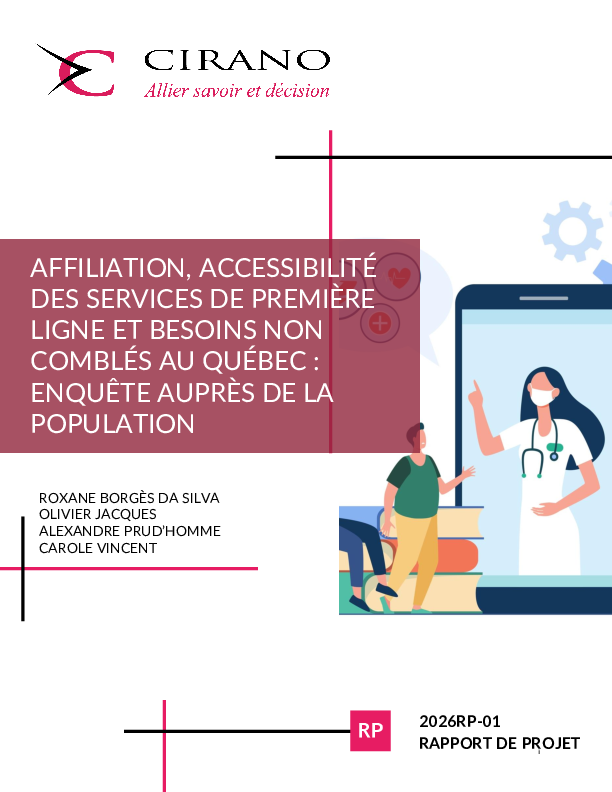
Affiliation, accessibilité des services de première ligne et besoins non comblés au Québec
Enquête auprès de la population
This study provides an overview of affiliation with a primary care service provider (e.g., Family medicine group, clinic), the accessibility of these services and the unmet needs reported by the population. The analyses are based on a survey of a representative sample of the Quebec population using validated Statistics Canada instruments to report on respondents’ healthcare experiences.
The results indicate that four out of five people report having a regular source of primary care services. Of these, 80% identify their primary provider as a family doctor, and 8% as a nurse. However, only 15% of respondents report being able to get an appointment on the same day or the next day with their usual source of care. In the absence of their usual provider, three out of four respondents say they can consult another professional within the same organization.
In addition, one in three respondents reported having unmet health needs. Having unmet needs refers to a person’s inability to obtain the healthcare, they believe they need. Half of these needs relate to a new health problem, while about 40% are related to a follow-up for an existing problem. The main reasons cited for these unmet needs are related to the inability to obtain services within a reasonable time frame.
In conclusion, although the majority of Quebecers report having a regular source of primary care services, access remains a major issue: only 15% of respondents can get a consultation quickly when a need arises. Membership or registration with a primary care organization alone is therefore not enough to guarantee accessibility. It must be accompanied by other structural measures or policies aimed at improving real access to care for the entire population.